How a wooden foot roller actually works (and what it can't do)
The real mechanics behind a wooden foot roller, what the reflexology and circulation claims can and can't support, and how ours is turned in Sillanwali.
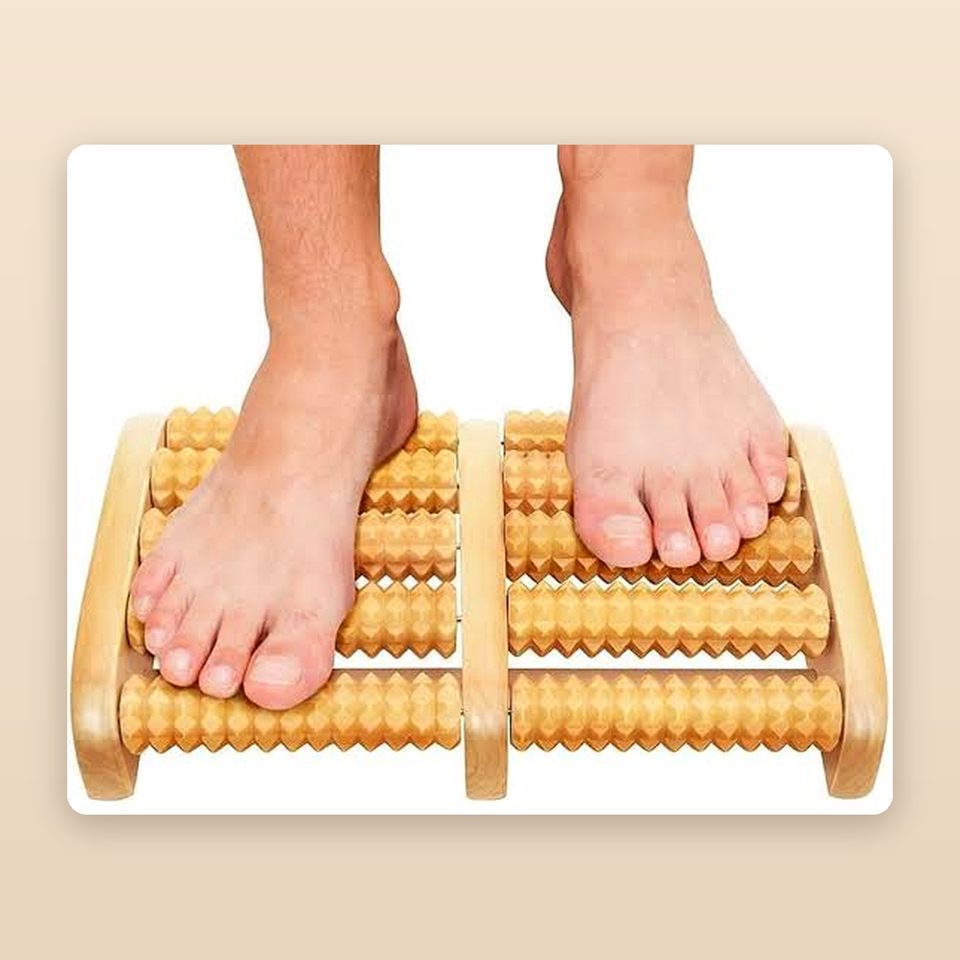
A wooden foot roller works through simple mechanics, not magic: ridged rollers press into the sole and arch as you move your foot, and that pressure and friction is what you feel. The wider reflexology claim — that spots on the foot map to organs — has no accepted scientific mechanism behind it.
What actually happens when you roll your foot over it?
Your body weight pushes the sole down onto the rollers, and because the surface is ridged rather than flat, that weight concentrates into narrow lines of contact instead of spreading evenly. Moving your foot back and forth adds a rolling, stroking motion on top of that pressure, so the skin, fascia and surface muscle under your foot go through a repeated squeeze-and-release cycle rather than one constant press. That mechanical pattern — pressure, movement, release — is the entire mechanism. There's no vibration, heat or electrical stimulation involved; a wooden roller only does what your own weight and movement make it do.
Why are the rollers ridged rather than smooth?
A ridged surface delivers more pressure per point of contact than a smooth cylinder of the same weight, because the load is carried by narrower lines rather than the full curve of the roller. Ours are ridged by design, not left smooth — worth stating plainly, since we found the product's own CMS listing text describing them as "smooth rather than ridged" and corrected that after checking it against the owner and the actual product photo. If you're comparing rollers online, this is one of the few genuinely functional differences between models, rather than a cosmetic one.
Is the reflexology idea — that foot zones map to organs — backed by science?
No accepted anatomical pathway has ever been demonstrated connecting a specific point on the sole to a specific internal organ, and that part of reflexology theory remains a belief system rather than an established physiological finding. The relaxation and localised pressure relief people feel from rolling their feet is real and doesn't need the organ-map story to explain it — pressing on tired tissue and moving it around simply feels good and eases tension, the same way rolling a tight calf or forearm does.
Why do so many listings state these benefits as settled fact?
Search for a wooden foot roller and most of what comes up states reflexology and circulation claims as flat medical fact — treats plantar fasciitis, breaks down scar tissue, balances energy flow — with no source and no distinction between a genuine mechanical effect and a folk theory layered on top of it. That happens because most of these pages are written to sell a generic import rather than by anyone who actually turns the thing on a lathe. We'd rather say plainly what a hand-turned wooden roller does and doesn't do than borrow language from a listing we wouldn't stand behind ourselves.
Does it actually improve blood circulation?
There's a short-term, local effect that's easy to explain: pressing on the sole squeezes blood out of the compressed capillaries, and releasing the pressure lets blood flow back in, which can leave your foot feeling warmer for a few minutes. That's a real, transient response to mechanical pressure, not evidence that rolling your feet improves circulation more broadly or treats a circulatory condition — those are two different claims, and only the first one is something a roller can actually do.
What can a foot roller do, and what can't it do?
Put plainly, it's a mechanical tool with a short, honest list of things it does well — and a much longer list of things it gets credited with online that it simply can't do.
- Can: give short-term relief to tight, tired soles after a day on your feet.
- Can: give you a physical reason to sit down, stay still and stretch your feet for a few minutes.
- Can: work the arch and heel in a way that's hard to do with your hands alone.
- Can't: treat a diagnosed medical condition such as plantar fasciitis, neuropathy or poor circulation.
- Can't: replace a physiotherapist, podiatrist or GP for persistent pain.
- Can't: work through organ-specific reflex points, whatever the marketing copy on other listings claims.
How long and how often should you roll your feet?
General foot-care guidance suggests short sessions — a couple of minutes per foot — are enough to work the heel, arch and ball without irritating the skin, and that doing this a few times a week beats one long session. This is general wellness guidance, not instructions specific to any medical condition; stop straight away if you feel sharp pain rather than a dull, releasing pressure.
Should it hurt while you're using it?
It should feel like firm, deep pressure that eases off the longer you roll, not a sharp or stabbing pain. Sharp pain is a signal to lift your foot and ease off, not to push through it — whatever a before-and-after marketing claim implies, pain isn't proof that a wooden roller is doing more good. Broken skin, a bruise or numbness on the sole means you pressed too hard or too fast for that session, not that the tool needs to be used harder next time.
Does solid wood work differently to plastic or foam rollers?
A solid, hand-turned wood roller keeps its shape and ridge profile permanently — it can't flex flat under weight the way a hollow plastic shell can, or compress and soften over time the way foam does. The trade-off is weight and rigidity: it's heavier to move around and the pressure isn't adjustable the way a spring-loaded plastic roller sometimes is. Ours measures roughly 28–33cm (11–13in) long, 18–20cm (7–8in) front to back and 5–6.5cm (2–2.5in) high, and isn't identical piece to piece since it's turned individually rather than injection-moulded — see our full sizing guide for the exact range.
Wooden foot massager: full sizing and buying guide
How is ours actually made?
Turned on a khraad — a pole lathe — in Sillanwali, a woodworking town in Sargodha district, Punjab, that's worked this way for roughly three hundred years. The same hand-turning process shapes bowls, rolling pins and roti presses in the same workshops, which is also why no two rollers come out quite identical — a lathe operator is shaping each ridge by eye and feel, not running a fixed CNC program. If you want to see that process in more detail, we've documented it step by step on a sheesham bowl, from raw log to finished piece.
How a sheesham bowl is turned, from log to finished piece
How do you buy a wooden foot massager in Pakistan?
This is the market where the checkout works end to end today: order directly on the product page for Rs. 1,199 plus a flat Rs. 250 delivery charge, paid cash on delivery, and it arrives within 3 to 4 days anywhere in Pakistan — no advance payment and no account needed.
Order in Pakistan — Rs. 1,199, cash on delivery
How do you buy one from the UK?
The online checkout only handles cash-on-delivery orders inside Pakistan, so a UK order goes through the workshop directly — message on WhatsApp or by email with your address, and shipping and payment are arranged with you before anything is sent, the same way every other piece is handled for international delivery.
Frequently asked questions
- How does a wooden foot roller work, mechanically?
- Ridged rollers press into the sole and arch as your body weight rests on them, and moving your foot back and forth adds a repeated squeeze-and-release motion. That's the whole mechanism — pressure and movement from a fixed wooden shape, with no motor, heat or vibration involved.
- Why are the rollers ridged rather than smooth?
- A ridged surface concentrates your body weight into narrow lines of contact instead of spreading it across a smooth curve, so it delivers more pressure per point for the same weight. Ours are ridged by design — an early version of the product listing incorrectly described them as smooth, which we corrected after checking with the workshop and the product photo.
- Is the reflexology theory behind foot rollers scientifically proven?
- No accepted anatomical pathway has been shown connecting specific points on the foot to specific internal organs, so that part of reflexology theory remains a belief system rather than an established finding. The relaxation and pressure relief people genuinely feel doesn't depend on the organ-map story being true.
- Is the circulation benefit real, or just marketing?
- There's a real short-term local effect — pressing on the sole squeezes blood out of compressed capillaries, which flows back in once you release the pressure, leaving your foot feeling warmer briefly. That's different from a broader claim that rolling your feet improves circulation generally or treats a circulatory condition, which isn't something a wooden roller can do.
- How long and how often should you roll your feet?
- General guidance is a couple of minutes per foot, a few times a week, rather than one long session — enough to work the heel, arch and ball of the foot without irritating the skin. Stop if you feel sharp pain rather than a dull, releasing pressure.
- Can a wooden foot roller replace physiotherapy or a professional massage?
- No. It's a self-care tool for everyday tension and tired feet, not a treatment for a diagnosed condition — persistent pain, plantar fasciitis or a circulation problem should go to a physiotherapist, podiatrist or GP rather than a roller.
- Does solid wood work better than plastic or foam rollers?
- A solid hand-turned wood roller keeps its ridge profile permanently and can't flex flat or soften with use the way hollow plastic or foam can, though it's heavier and the pressure isn't adjustable. It's a durability and firmness trade-off rather than a straightforward upgrade.
- Can a foot roller be used on hands or calves as well as feet?
- The same rolling motion works reasonably well on tight calves or the palm of the hand, since the mechanism — pressure plus movement over ridged wood — isn't specific to feet. Ours is sized and shaped for feet, so it's less practical for a larger muscle like a calf than a dedicated roller would be.