How a sheesham bowl is turned, from log to finished piece
A sheesham log becomes a bowl on a khraad, the same lathe used across Sillanwali's workshops — roughed, hollowed, sanded and finished by hand rather than moulded.
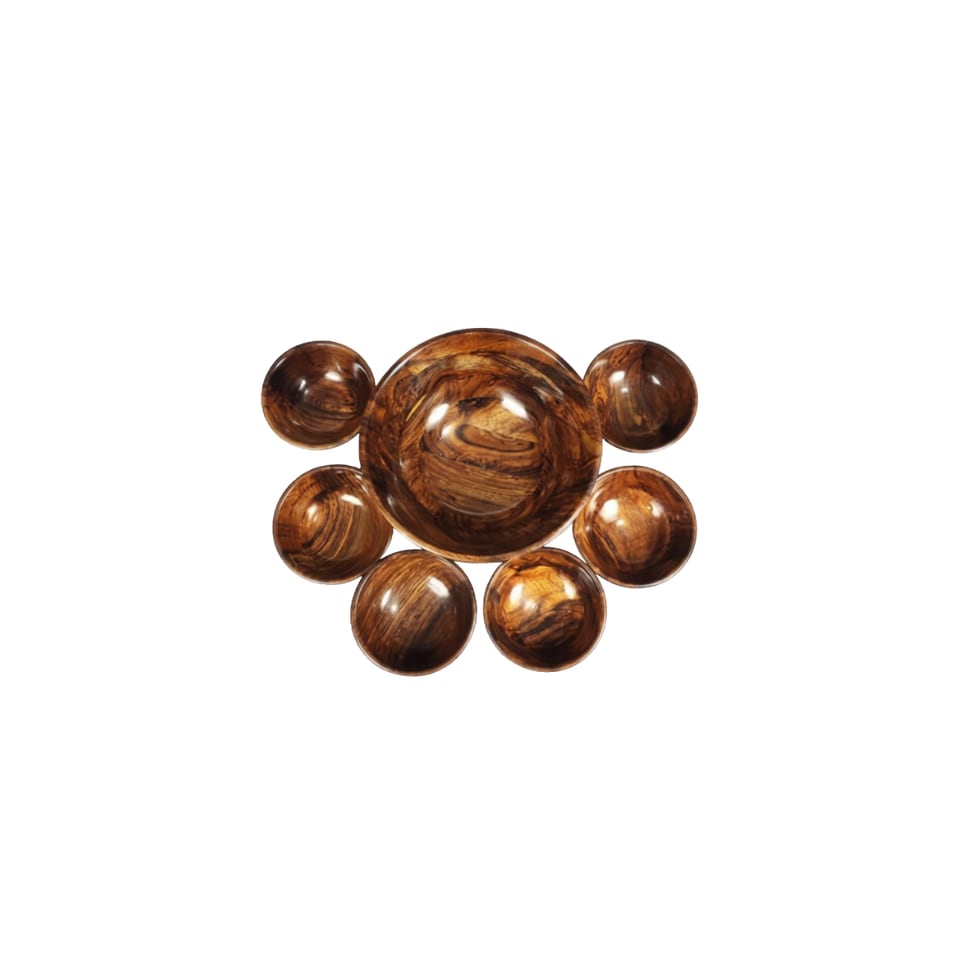
A sheesham log is cut into a rough disc, mounted on a spinning lathe called a khraad, and shaped by hand with a fixed cutting tool held against the turning wood. The bowl is roughed to shape, hollowed, sanded while it still spins, then finished — left plain, contrast-polished, or lacquered.
What actually shapes the wood — is it a machine or a hand tool?
Both, in the sense that matters: the lathe spins the wood, but a person holds the cutting edge against it and controls every pass by hand. Nothing about the shape is programmed or automated the way a CNC router works from a file, and no two passes of the tool are ever identical, even on the same piece. In Sillanwali's workshops this lathe is called a khraad, the same machine used to turn bowls, trays, vases and boxes before any lacquer or carving is added.
How does a rough log become a round blank?
A block of sheesham is first cut roughly to size — slightly larger than the finished piece, since turning removes material to true it up. It's then centred and mounted on the khraad so the whole block rotates evenly on one axis; only once it's spinning true does the actual shaping start.
What are the actual stages between mounting the wood and a finished bowl?
The sequence is the same whether the finished piece is a bowl, a tray or a box — only the shape and the finishing step change.
- Roughing — the block is cut down from a square-edged blank to a true, even cylinder or disc.
- Outside shaping — the outer profile of the bowl, tray or vase is cut while the wood still spins on the outside face.
- Hollowing — for anything that needs to hold something, the inside is cut away to depth, working from the centre outward.
- Sanding — done while the piece is still turning, so the finish is even all the way round rather than patchy.
- Finishing — the piece comes off the khraad to be oiled, polished, or lacquered, depending on which finish it's getting.
Nothing here is automated between stages — the same person who roughs the outside typically hollows the inside and sands it, since the tool never leaves contact with a spinning workpiece for long enough to hand off cleanly.
Does turning waste a lot of the wood?
Some, unavoidably — hollowing a bowl removes a solid core of material as shavings, and a dense hardwood like sheesham isn't cheap to waste. In many turning workshops, the offcuts and trimmed-down centres from a larger piece are kept aside as blanks for smaller turned items rather than thrown away, which is one practical reason a bowl set with several sizes makes sense to turn together rather than one size at a time.
Is sheesham actually a good wood for turning?
Yes — it's one of the reasons the craft settled around this wood rather than a softer local timber. Sheesham (Dalbergia sissoo, sold in the UK as Indian rosewood) is dense and tight-grained, so it holds a clean edge under the cutting tool instead of tearing or splintering, and it takes a polish well once it's finished.
How long does it take to turn one bowl?
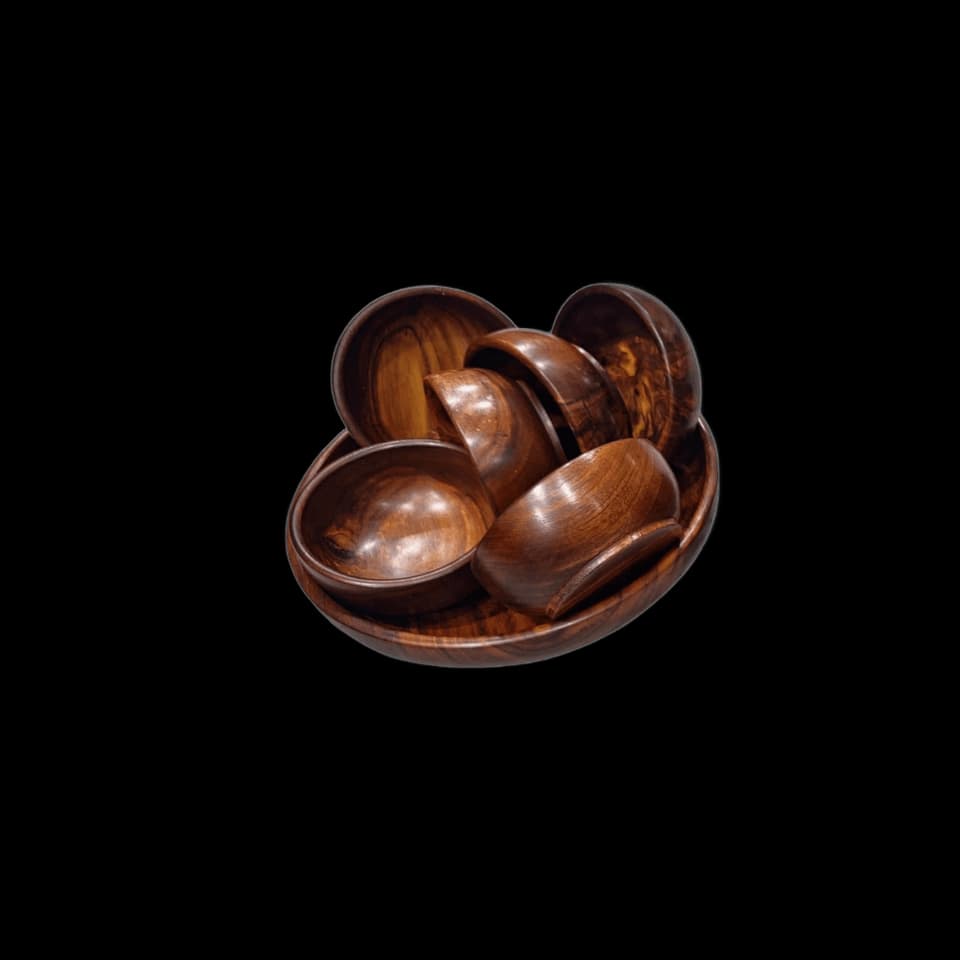
The turning itself is the fast part of the process; a practised hand can rough out a simple bowl shape in well under an hour. What takes longer is everything around it — for our Wooden Bowl Set, which pairs one large bowl with six small ones, the whole run takes about 7 working days in the workshop, covering turning all seven pieces, sanding, and finishing.
What happens to a piece after it comes off the lathe?
- Plain — sanded and sealed so the natural sheesham grain stays visible, no added colour.
- Contrast polish — the piece is polished in two tones so the grain and the turned rings both stand out.
- Red lacquer — coloured lac is applied while the piece is back on the lathe and still spinning, then set.
Does colour get added on the lathe, or afterwards?
For lacquered pieces, the colour goes on while the wood is still turning — coloured lac is held against the spinning surface so the friction melts it into an even coat, the same in-motion step used across naqshi lacquer work more broadly. Plain and contrast-polish pieces skip this step and are finished off the lathe instead.
Is a khraad different from the power lathes used in UK workshops?
The underlying principle is identical — a workpiece rotates on an axis while a fixed hand tool cuts it, so a hand-turned bowl from either tradition shows the same telltale rings once it comes off. What differs is naming and what happens next: khraad is simply the term used across Punjab's workshops for this lathe, and in Sillanwali specifically it's also the machine coloured lac is applied on, a step that isn't part of most Western turning traditions at all.
Why does one hand-turned bowl look slightly different from its pair?
Because a person is reading the grain and adjusting the cut as they go, rather than a mould reproducing an identical shape every time. Two bowls from the same set will match in size and finish but carry small differences in grain pattern, and the exact colour of the sheesham itself can vary slightly piece to piece since it comes from different sections of timber — that variation is normal on hand-turned wood, not a flaw.
How can you tell a bowl was turned by hand rather than machine-moulded?
Turn it over. A lathe-turned base carries faint concentric rings running with the grain, left by the cutting tool as the wood rotated — a moulded or cast piece has a smooth, seamless underside instead. Weight is a second clue: solid turned sheesham feels noticeably heavier in the hand than a resin or composite piece of the same size.
What sizes does a turned bowl come in?
- Large bowl — 9 in (about 23 cm) across.
- Small bowls — 4 in (about 10 cm) across, sold six to a set alongside the large bowl, or four to a set in the plain finish.
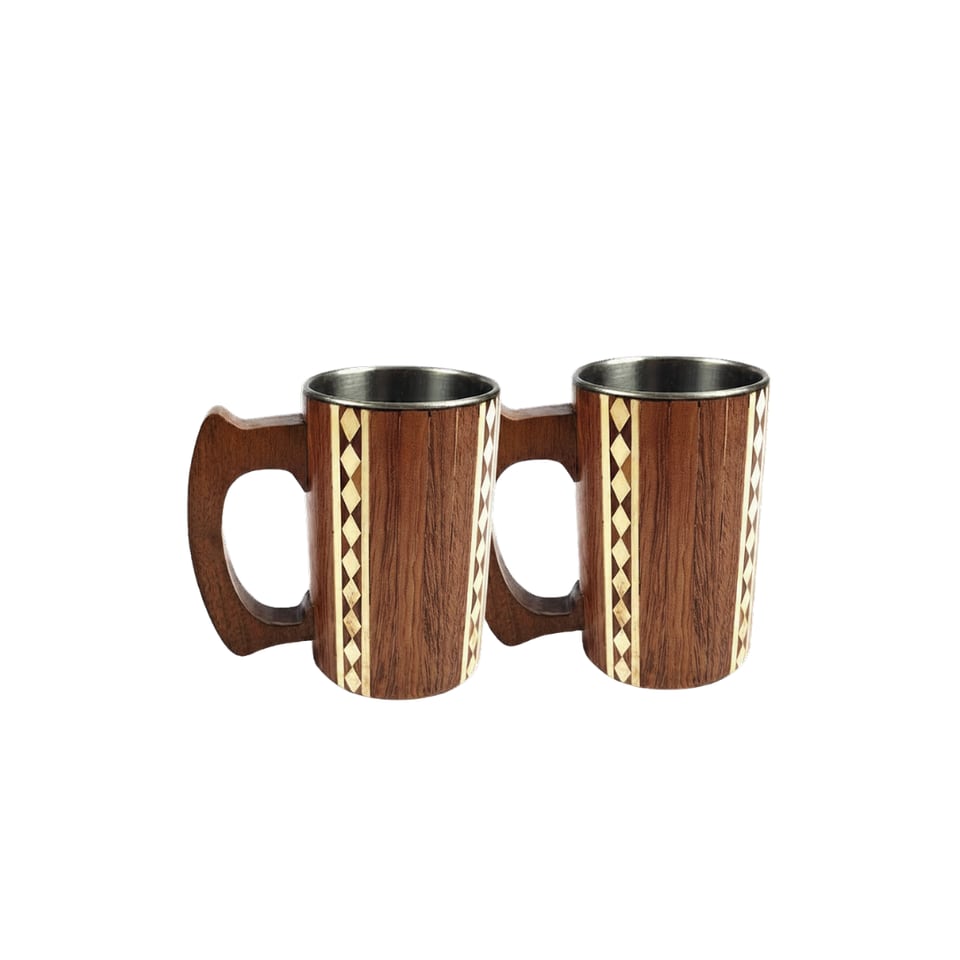
- For comparison, our wooden mugs are turned to 5 in (about 13 cm) tall, with a food-grade steel liner fitted inside so hot drinks never touch the wood directly.
None of this is visible once a bowl is sitting on a UK dining table, which is exactly why it's worth checking before you buy. A listing photo can't show whether a piece came off a khraad or out of a mould — but the base of the piece, once it arrives, always tells you.
Choosing between sheesham, mango and acacia? Read the wood comparison
Frequently asked questions
- What tool actually cuts the wood on a lathe?
- A hand-held cutting tool — a gouge or chisel — is pressed against the wood as it spins on the khraad. The lathe supplies the rotation; the shape comes entirely from how the person holding the tool controls the cut, which is why no two turned pieces are perfectly identical.
- Is sheesham a good wood for turning on a lathe?
- Yes. Sheesham (Dalbergia sissoo) is dense and tight-grained, which lets it hold a clean cut under the tool rather than tearing, and it takes a polish or lacquer well once turning is finished. It's the standard wood for bowls, trays and vases turned in Sillanwali's workshops.
- How long does it take to turn a wooden bowl?
- The turning step itself can take well under an hour for a practised hand on a simple shape. A finished piece takes longer once sanding and finishing are added — our Wooden Bowl Set, seven pieces in total, takes about 7 working days to make.
- Can you tell if a bowl was hand-turned or made in a mould?
- Turn it over. A hand-turned base shows faint concentric rings from the cutting tool, running with the direction the wood was spun — a moulded or cast piece has a smooth, uniform underside with no tool marks. Solid turned wood also feels heavier than a resin piece of the same size.
- Why do hand-turned bowls vary slightly from each other, even in the same set?
- Because the shape comes from a person reading and cutting the grain in real time, not from a mould repeating one exact form. Pieces in the same set match in size and finish, but small differences in grain pattern between them are normal, not a defect.
- Is a turned wooden bowl food-safe to use straight away?
- It depends on the finish. A plain or contrast-polished bowl sealed with a food-safe oil is fine for dry food such as fruit, nuts or bread. A lacquered piece is a display finish rather than a food-contact one, so it's better suited to holding wrapped or packaged items than food that touches the surface directly.
- Is wood turning the same everywhere, or does Sillanwali do it differently?
- The physical principle — a fixed tool cutting a spinning workpiece — is the same on any lathe worldwide. What's specific to Sillanwali is what happens next: coloured lac applied while the piece is still turning, and hand-scratched naqshi decoration, neither of which is standard on a plain Western-turned bowl.