Buying a wooden rehal, Quran stand or Islamic wall art in the UK
What a rehal actually is, how to choose between Sillanwali's hand-carved Islamic wall art pieces, and real sheesham sizes in cm and inches for UK delivery.
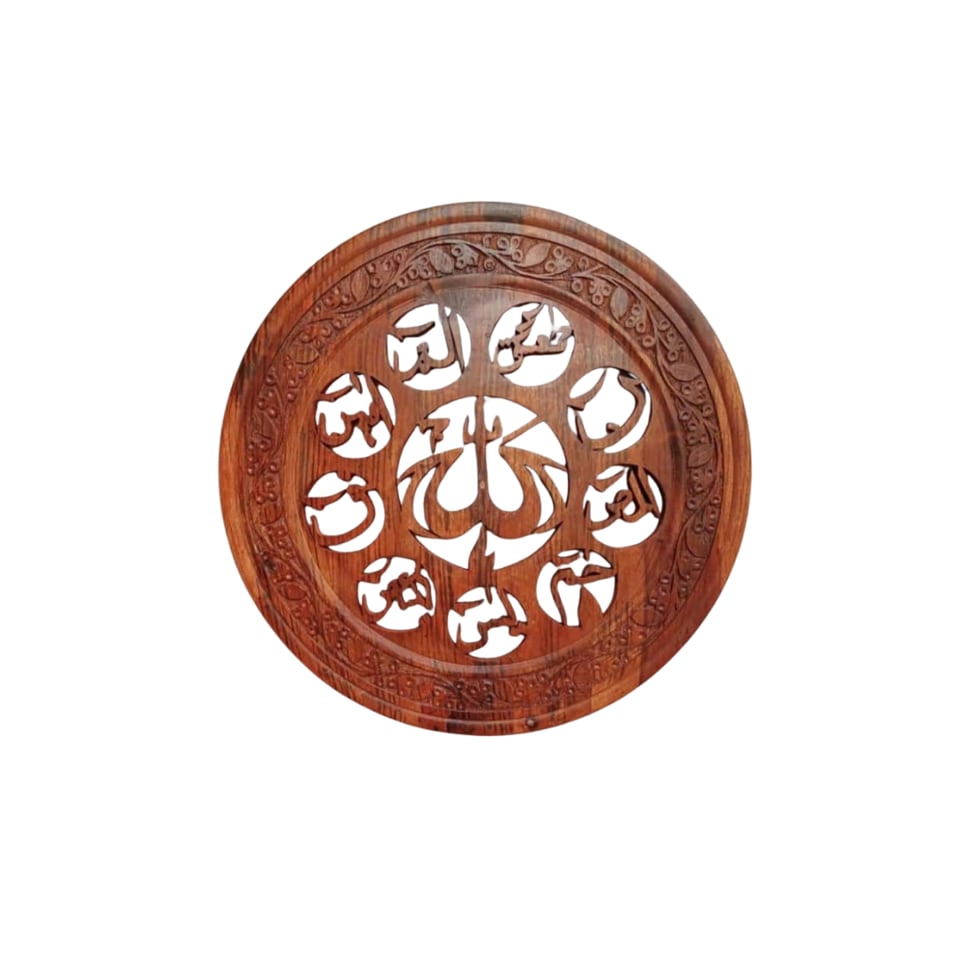
A rehal is the traditional folding wooden stand used to hold the Quran open for reading. Sillanwali, a woodworking town in Sargodha, Punjab, hand-carves the related Islamic wall art — Ayat-ul-Kursi panels, Bismillah plaques, Asma-ul-Husna plates — from solid sheesham, cut freehand as openwork, and ships to the UK made to order.
What's the difference between a rehal and a standing Quran stand?
A rehal is the traditional folding X-shaped stand that holds the Quran open at a reading angle on the floor or a low table, then folds flat for storage afterwards. A standing Quran stand is taller and usually sits on a desk or bedside table. Both exist for the same reason — keeping the Quran raised rather than placed directly on the floor.
Does Sillanwali sell a folding rehal, or hand-carved wall art?
Honestly: mostly wall art. Sillanwali's workshop specialises in openwork Islamic calligraphy panels — Ayat-ul-Kursi, Bismillah, Kalima, Asma-ul-Husna and the Four Quls — each cut freehand from one sheesham board rather than routed by machine. A folding rehal isn't a stocked catalogue size; it's taken on as a custom commission, sized to fit your own Quran, agreed on WhatsApp before the wood is cut.
Why sheesham, and how does it hold up in a centrally heated UK home?
Sheesham (Dalbergia sissoo, sold in the UK as Indian rosewood) is dense and moves less with humidity than softer timbers, which is why it holds fine openwork cutting without the letters chipping out at the edges. A centrally heated house dries the air over a full winter the same way as any solid wood piece, so a light rub of food-safe oil twice a year keeps the grain from tightening and the cut-out sections from hairline cracking at the joins.
What sizes do the wall panels actually come in?
- Ayat Wall Panel — 14 in (36 cm) across, round, openwork calligraphy inside a carved floral border. 12 days to make.
- Bismillah Wall Plaque — 14 in (36 cm) across, high-gloss finish. 12 days to make.
- Kalima Leaf Wall Art — 14 x 12 in (36 x 30 cm), cut in a leaf shape from one board. 12 days to make.
- Four Quls Wall Plaque — 16 in (41 cm) across, four openwork panels around a centre medallion. 14 days to make.
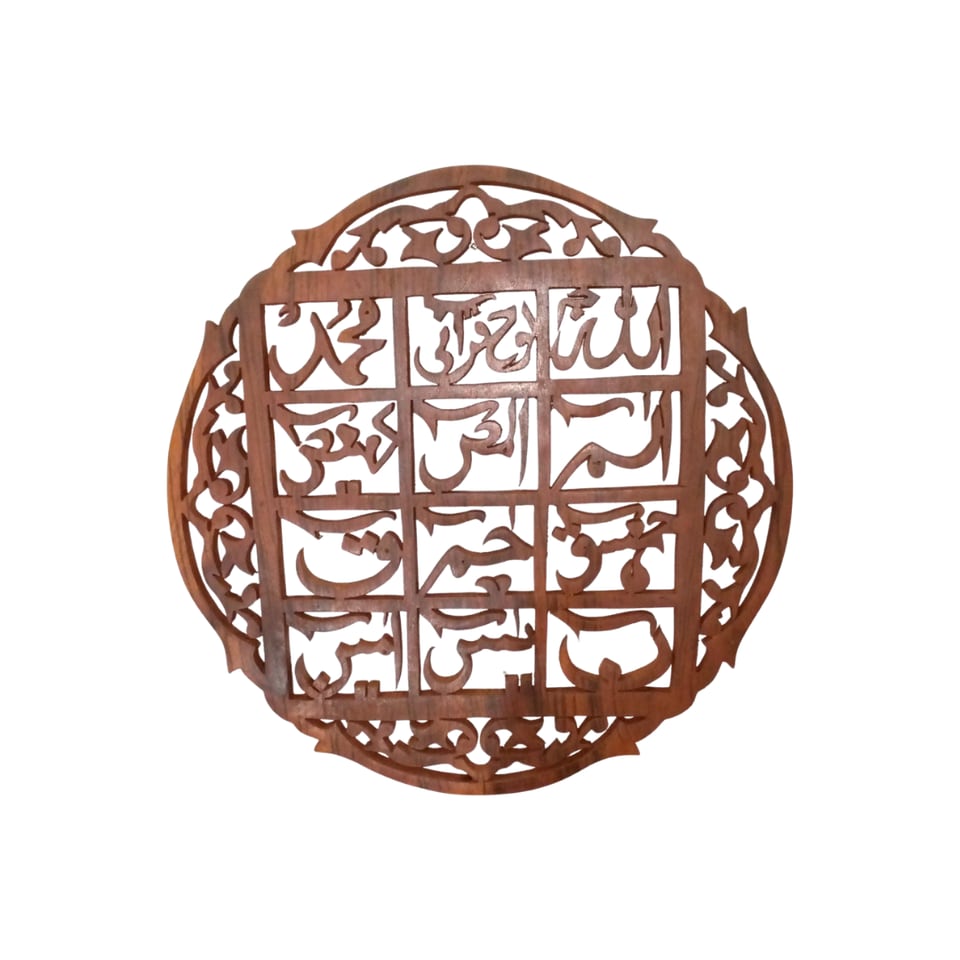
- Asma-ul-Husna Wall Plate — 18 in (46 cm) across, the largest piece, names of Allah cut in a grid. 14 days to make.
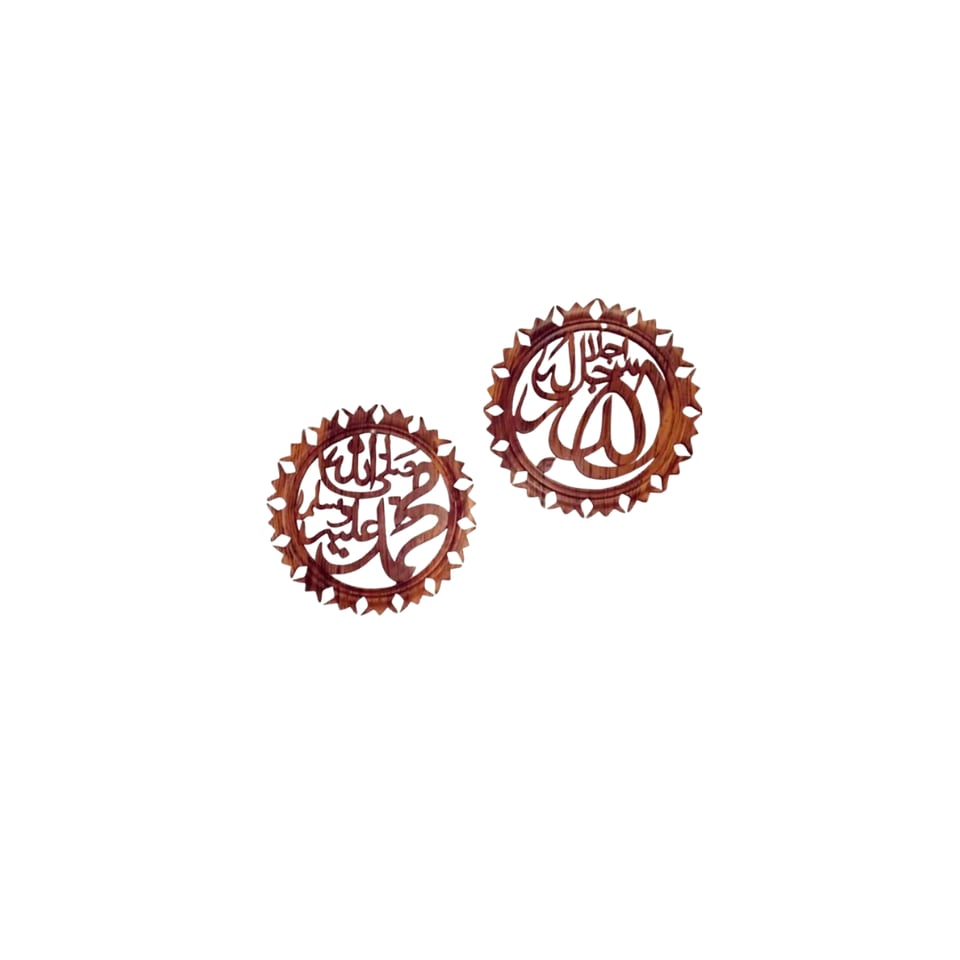
- Allah & Muhammad Roundels — a pair, 8 in (20 cm) each. 10 days to make.
Islamic wall art from Sillanwali
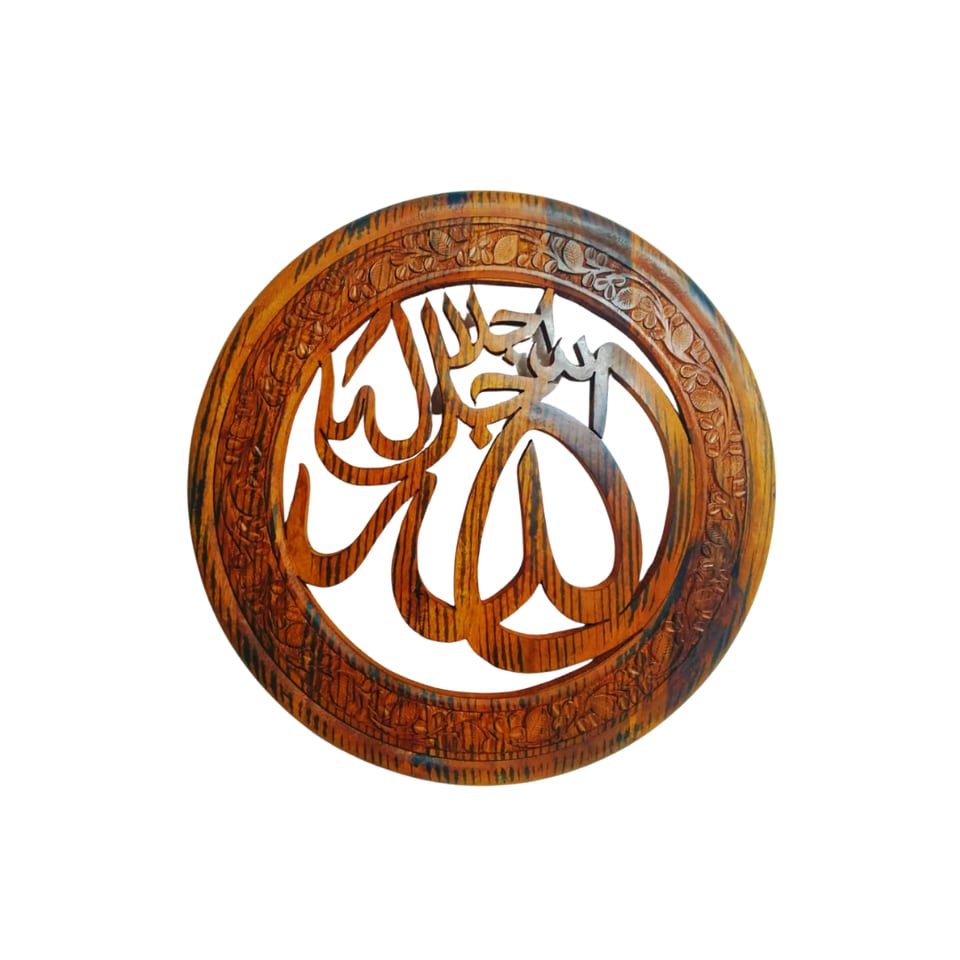
- Ayat-ul-Kursi wall panel — round openwork carving so light passes through the calligraphy.
- Bismillah wall plaque — the most-ordered piece for a new-home entrance.
- Kalima wall art cut in a leaf shape.
- Four Quls wall plaque — four panels around a centre medallion.
- Asma-ul-Husna wall plate — 99 names of Allah arranged around a circular sheesham disc.
- Allah & Muhammad roundels — a matching pair for either side of a doorway.
How do you choose between a single panel and a pair of roundels?
A single panel such as the Ayat Wall Panel (14 in / 36 cm) or Asma-ul-Husna plate (18 in / 46 cm) works as a centrepiece above a sofa, mantelpiece or bed. The Allah & Muhammad Roundels are sold as a pair, 8 in (20 cm) each, and are made to flank a doorway or a mirror rather than stand alone — at 10 days to make, they're also the fastest piece in the range to turn around.
Is hand-cut wall art different from laser-cut Islamic calligraphy?
Yes. Most Islamic wall art sold online is laser-cut or CNC-routed, which is fast but leaves faint scorch marks along the letter edges and a uniform, machine-repeated line. Sillanwali's panels are cut freehand with a fine blade, one letter at a time, so the openwork edges carry small, individual tool marks rather than a burnt, identical outline — the difference is visible up close, and it's the reason a panel takes 10 to 14 days rather than an afternoon.
Can a wall panel or rehal commission be personalised?
Yes. A short dedication can be engraved on the border or the back of a panel — a parent's name, a hafiz's Ameen date, a Nikkah date. Because engraving is done by hand, English, Urdu, and Arabic scripts are all possible. Share the exact spelling and script in the order notes and the craftsman sends a proof photo before polishing.
Shipping a Quran stand or wall panel to the UK
Every piece is cut after the order is placed rather than pulled from stock, so allow 10 to 14 days in the workshop depending on the panel. International orders are paid in advance and shipped by DHL; because cost and transit time depend on the destination and the size of the piece, message us on WhatsApp for a current quote to your UK address.
How do you care for a wooden Quran stand or wall panel?
- Dust openwork panels with a soft dry brush — do not use a wet cloth on painted or gloss areas.
- Keep wooden Quran stands and wall panels out of direct sun so the finish does not dry out.
- A thin coat of food-safe oil on plain sheesham every six months keeps the grain looking rich.
See the Allah & Muhammad Roundels
Read how naqshi lacquer is made
Frequently asked questions
- What is a rehal used for?
- A rehal is a folding X-shaped wooden stand that holds the Quran open at a comfortable angle for recitation on the floor or a low table. It is the traditional Quran stand used across Pakistan and the wider Muslim world.
- What size is a Quran stand or rehal?
- Most rehals sold in the UK fold out to roughly 14–18 inches (36–46 cm) high. Sillanwali doesn't keep a fixed rehal size in stock — a folding rehal is taken on as a custom commission sized to fit your own Quran, so tell us the book's dimensions and we quote from there.
- Is it considered disrespectful to place the Quran directly on the floor?
- Many households treat it that way, which is the practical reason a rehal or stand exists — it keeps the Quran raised off the floor or the table surface during reading rather than resting flat on it.
- What wood are the Quran stands and wall panels made from?
- Sheesham (Dalbergia sissoo), sold in the UK as Indian rosewood. It's dense, resists warping, and holds fine openwork carving without the letters chipping — the reason it's the standard wood for this kind of calligraphy piece.
- Can a wall panel or rehal be personalised with a name or date?
- Yes. A short dedication — a name, a Nikkah date, an Ameen date — can be hand-engraved on the border or back of a panel. Add the exact wording and script in the order notes and a proof photo is sent before polishing.
- Does a wooden rehal fold flat for storage?
- Yes, that's the point of the traditional X-shaped design — it opens to support the Quran at an angle for reading, then folds flat to put away afterwards, unlike a fixed standing Quran stand.
- Do you ship Quran stands and Islamic wall art to the UK?
- Yes. Pieces are made to order in Sillanwali, Pakistan — allow 10 to 14 days in the workshop — then shipped to the UK by DHL, paid in advance. Message us on WhatsApp for a current shipping quote and transit time.
- What's the difference between hand-carved and laser-cut Islamic wall art?
- Laser-cut and CNC-routed panels are quick to produce but leave faint scorch marks and a uniform, repeated line along the letter edges. Sillanwali's pieces are cut freehand with a fine blade, letter by letter, so the openwork carries small individual tool marks instead — visible up close, and the reason a panel takes 10 to 14 days rather than an afternoon.