Foot Reflexology Basics: What It Is and What Research Actually Says
Foot reflexology explained simply: what the foot charts claim, what NCCIH says research shows, and how a wooden roller differs. Honest guide for Pakistan.
Foot reflexology is a practice where pressure is applied to specific points on the feet, based on the belief that each point matches another part of the body. The US National Center for Complementary and Integrative Health (NCCIH) says the claimed effects on those body parts have not been proven. Many people still find a foot massage relaxing.
What is foot reflexology?
Reflexology is a practice in which different amounts of pressure are applied to specific points on the feet or hands. Practitioners, called reflexologists, usually use their thumbs and fingers, working across the sole, heel, toes and the sides of the foot in a set order.
The idea behind it is that the foot works like a small map of the whole body. In that map, the toes are linked to the head, the ball of the foot to the chest, the arch to the middle of the body, and the heel to the lower back. Pressing a point, the theory says, affects the matching area.
In Urdu conversations you will often hear it described as pairon ke points dabana (pressing points on the feet), and many of us grew up with a grandparent who swore by a firm foot press after a long day. That family habit is closer to plain foot massage than to formal reflexology, but the two often get mixed up online.
What does a reflexology foot chart show?
A reflexology foot chart is a drawing of the soles divided into zones, each labelled with a body part. You will find them printed on posters, slippers, mats and plastic rollers sold across Pakistan.
Charts are a teaching tool for the theory, not a scientific map. Different charts do not always agree with each other on where each zone sits, and no chart has been shown to predict or change how an organ works. If you look at one, read it as an illustration of what reflexologists believe, nothing more.
The same goes for phrases like "acupressure points on feet" on product boxes. Acupressure comes from a different tradition, and claims that pressing a spot on the foot works on a specific body part are not established. We don't make those claims about our massager, and you should be careful with any seller who does.
What does research actually say about reflexology?
Here is the honest summary, based on NCCIH's reflexology page:
- Reflexology is claimed to cause relaxation and benefits in the matching body parts, but this has not been proven.
- In one study funded by the US National Cancer Institute, women with advanced breast cancer who received reflexology showed improvement in a few symptoms, such as shortness of breath, but not others, such as nausea or pain. In that study, reflexology was safe even for the most fragile patients.
- A small amount of research suggests it might help a burning or prickling feeling sometimes linked to multiple sclerosis, but there isn't enough evidence for most multiple sclerosis symptoms.
- For irritable bowel syndrome, there is too little evidence to draw any conclusion.
So the fair reading is this: reflexology appears to be gentle and low-risk for most people, and a hands-on foot session can feel calming, but the organ-map idea is not backed by good evidence. If someone tells you reflexology will fix your sugar, blood pressure or kidneys, that is not what the research says.
Is a wooden foot roller the same as reflexology?
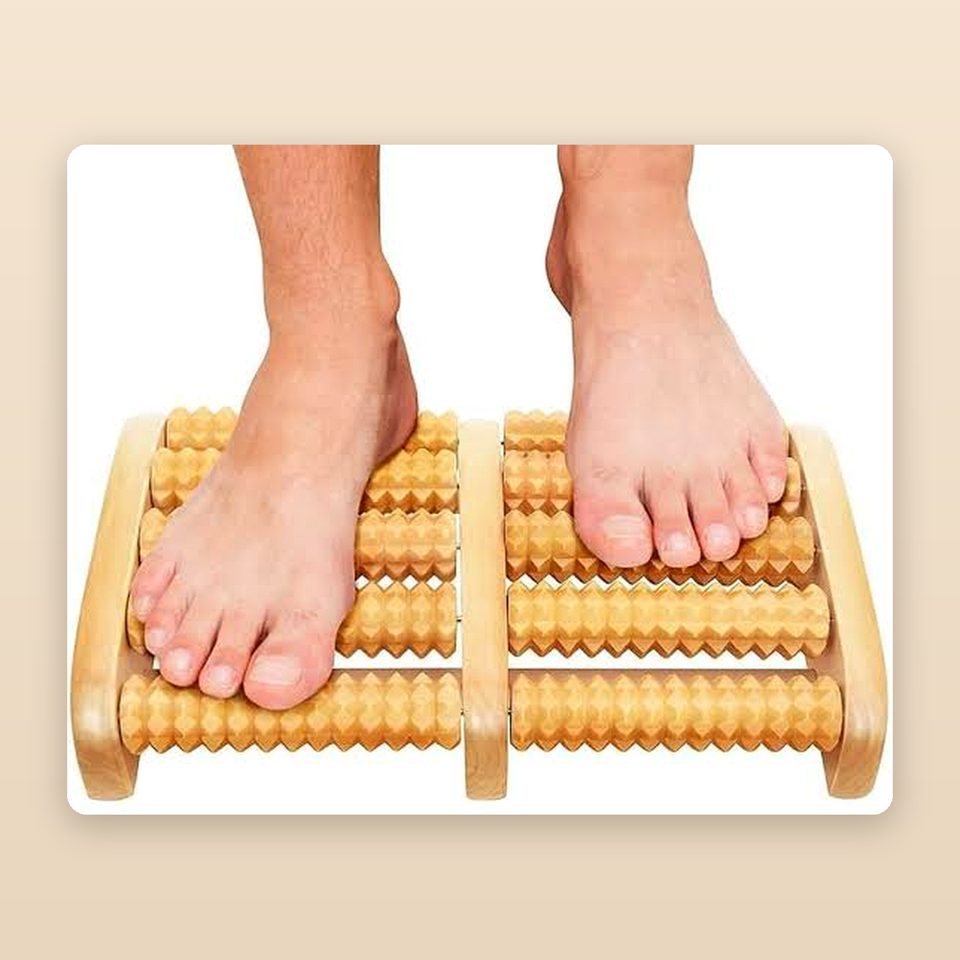
No. A wooden foot roller gives general foot massage, not targeted point work. When you sit and roll your soles over ridged wooden rollers, the pressure moves across the whole arch, heel and ball of the foot. It doesn't aim at a single "zone", and it isn't meant to.
That is actually the simpler, more honest use. Many people find a few minutes of rolling after work relaxing, the same way a hand massage on tired feet feels pleasant. It is a comfortable end-of-day habit, not a way to work on organs.
The Sillanwali Wooden Foot Massager is a handmade piece of natural wood from Sillanwali, Sargodha, Punjab, with dual-sided rollers for both feet. It is manual, used while seated, and needs no electricity or batteries. Its product page states that it is a manual relaxation product for home use and makes no medical claims. Our wooden foot massager benefits post covers what people can reasonably expect from it.
How can you enjoy a simple foot massage at home?
You don't need a chart or a trained practitioner to give your feet a few calm minutes. A gentle routine:
- Sit on a stable chair or sofa with both feet flat on the roller. Never stand on it.
- Check your soles for cuts, cracks or blisters first.
- Roll slowly from heel to toes and back for 3 to 5 minutes, letting the weight of your legs do the work.
- Ease off if any spot feels sharp or sore rather than pressing harder.
- Finish by flexing your toes and resting your feet for a minute.
Our how to use a wooden foot massager guide goes through posture and pressure step by step, and the foot massager side effects post lists who should avoid a roller or ask first.
how to use a wooden foot massager
When should you see a doctor?
This massager is a relaxation product, not a medical treatment. If foot pain is severe, lasts more than two weeks, keeps coming back, or comes with swelling, numbness or an injury, see a doctor.
If you have diabetes, speak to your doctor before using any foot massager. Diabetes can reduce feeling in the feet, so you may not notice pressure damage. Don't use it on numb feet, cuts, blisters or sores, and check your feet daily. Our foot massager for diabetics guide explains more.
Don't use reflexology or a roller in place of seeing a doctor for a health problem. It can sit alongside proper care as a relaxing habit, once your doctor is happy.
Want a simple, honest foot massager?
If a calm few minutes for your feet is what you're after, the Wooden Foot Massager costs Rs 1,499, and the massager comes with free delivery anywhere in Pakistan. You pay cash on delivery (COD), which means you pay the rider in cash at your door with no advance payment, and delivery usually takes 3 to 4 days. Order the Wooden Foot Massager or browse the Health & Wellness collection.
Frequently asked questions
- Does reflexology work on organs through the feet?
- NCCIH says reflexology is claimed to bring relaxation and benefits to linked body parts, but this has not been proven. Treat it as a relaxing foot massage, not a way to work on organs.
- Is reflexology safe?
- For most healthy people a gentle foot session is low-risk, and in one NCCIH-described study it was safe even for very fragile patients. Skip it on wounds, swelling, numbness or recent injuries, and ask a doctor first if you have diabetes or are pregnant.
- Can I follow a reflexology chart with a wooden roller?
- A roller spreads pressure across the whole sole, so it can't target chart zones. Use it simply as a general, relaxing foot massage.
- What is reflexology called in Urdu?
- There isn't one fixed Urdu word. People often describe it as pairon ke points dabana or pairon ki maalish, though maalish usually means ordinary massage.