Sillanwali handicrafts: the wooden lacquer craft of Sargodha, and how to order it
What Sillanwali handicrafts are, why one small town in Sargodha makes almost all of Pakistan's naqshi lacquer woodwork, what the workshops produce, and how to order a piece direct.
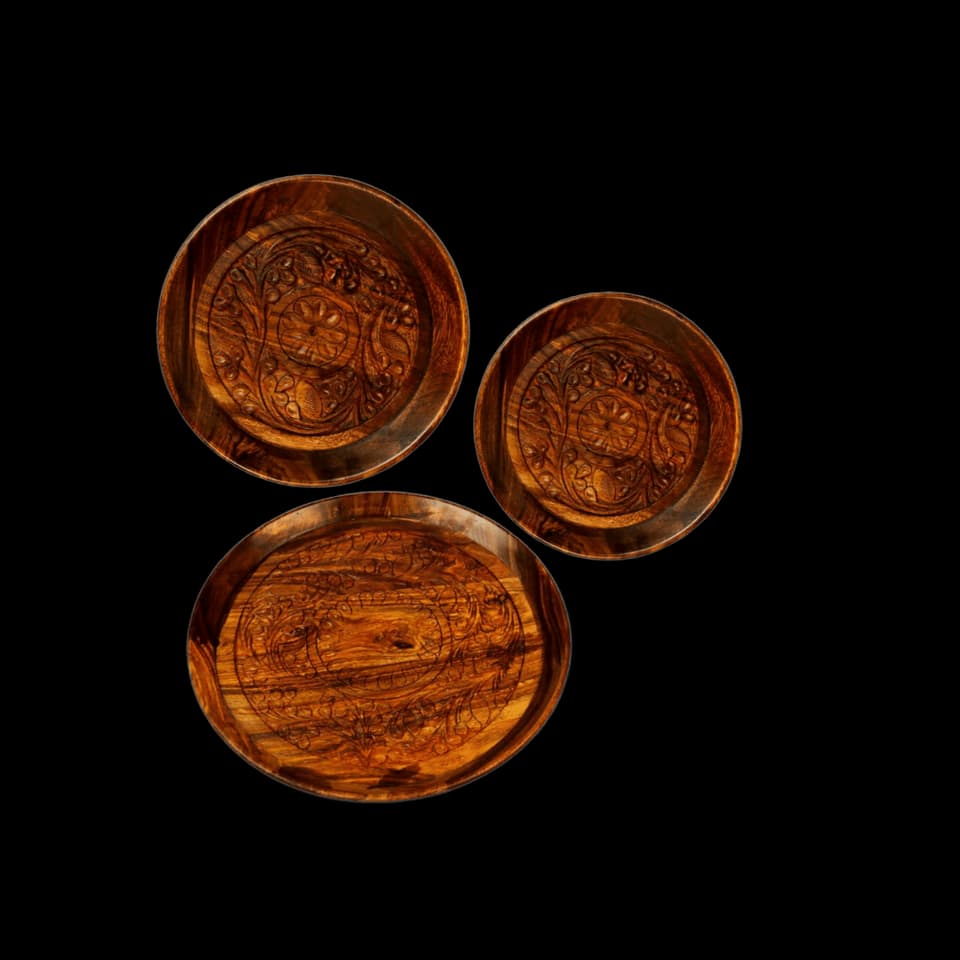
Sillanwali handicrafts are the hand-turned, lacquer-painted wooden pieces made in Sillanwali, a small town in the Sargodha district of Punjab, Pakistan. The technique is called naqshi: sheesham (rosewood) is turned on a khraad lathe, layers of coloured lac are melted onto the spinning wood by friction, and the design is then scratched back by hand so the colours underneath surface as fine rainbow lines. Roughly a hundred workshops in the town still work this way, ustad to apprentice, and almost all of Pakistan's lacquer woodcraft comes from here.
Why Sillanwali?
The craft is not native to the town. It traces to Kaithal, in the Punjab of undivided India, around 1710, in the lineage of Ustad Karmi. At Partition in 1947 artisan families crossed into the new Pakistan carrying their tools, their sticks of lac and the technique in their hands, and a large number of them settled in Sillanwali. What could have been lost took root instead. In 2007 naqshi work received the UNESCO Seal of Excellence.
What the workshops actually make
- Kitchen and dining: chakla belan sets, serving trays, chapati boxes, mortar and pestle, cutlery caddies, coaster sets.
- Islamic and spiritual: ayat panels, Bismillah plaques, Four Quls plaques, Asma-ul-Husna plates, Quran rehals and tasbeeh.
- Wall art: naqshi decorative plates, carved clocks, calligraphy roundels, leaf-form panels.
- Wedding and Nikkah: engraved plates, jewellery boxes, decorated surahi sets, dowry pieces.
- Executive gifting: desk sets, name plaques, pen stands, logo-engraved corporate orders.
- Games, toys and collectibles: carrom coins, chess sets, wooden trains and miniatures, charkha spinning wheels.
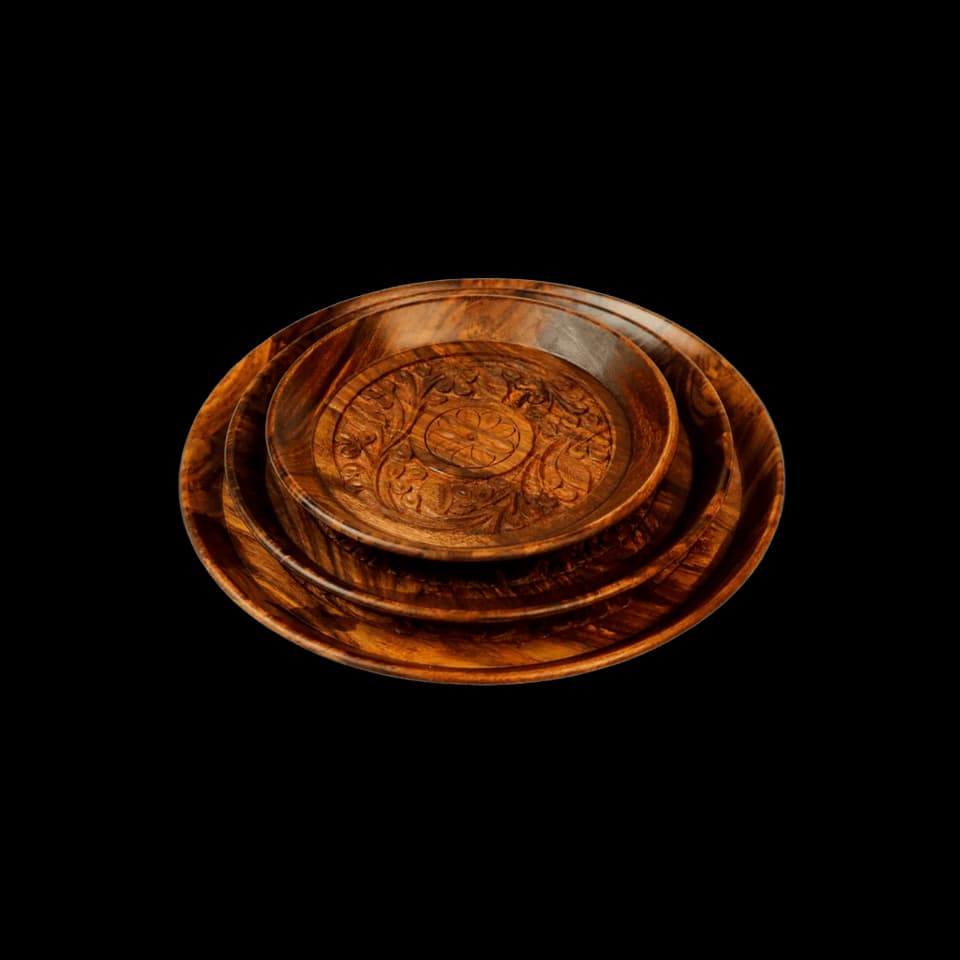
How a piece is made, step by step
- Turning — a block of sheesham is shaped on the khraad (traditional wood lathe).
- Lac layering — sticks of coloured lac are pressed onto the spinning piece; friction heat melts them on in layers, usually red, then yellow, then green.
- Naqshi scratching — the artisan cuts the pattern back through the layers by hand, so each stroke reveals a colour beneath.
- Carving or engraving — names, Nikkah dates, ayats or a company logo are cut last, in English, Urdu or Arabic.
- Finish — the piece is polished; food-contact items usually take a steel insert so the wood stays dry.
Every step is done by hand, so grain, carving depth and colour shift slightly from piece to piece. That variation is the craft, not a defect.
How to tell real Sillanwali naqshi from a print
- Look at the line, not the picture: scratched lac lines have a slight bevel and catch the light. Printed or transfer patterns are flat.
- Turn the piece over. A lathe-turned base carries faint concentric rings; a moulded or CNC base does not.
- Colours should sit in layers. If you can see one colour appearing inside the cut of another, it was scratched, not painted on top.
- Weight and smell: sheesham is dense and has a distinct rosewood scent at the unfinished base.
Buying direct from the workshop
Most Sillanwali handicrafts reach buyers through resellers in Lahore, Karachi and Islamabad, with a margin added at each step. Sillanwali Handicrafts is one of the town's own workshops and takes orders directly — including pieces that no reseller stocks, because they are made after you order rather than pulled off a shelf.
- Ready-made designs are listed in the collections with their prices; add one to your cart and check out.
- Custom orders cover engraving, non-standard sizes and your own design.
- Bulk and reseller orders start at 20 pieces, at wholesale rates.
- Payment in the shop is cash on delivery, anywhere in Pakistan, with delivery in 3 to 4 days. Orders from outside Pakistan are arranged directly with the workshop.
Where Sillanwali is
Sillanwali is a tehsil town in Sargodha district, Punjab, Pakistan, roughly 40 km south-east of Sargodha city and about three hours from Lahore by road. Handicrafts, along with agriculture, are what the town is known for.
Frequently asked questions
- What are Sillanwali handicrafts?
- Sillanwali handicrafts are hand-turned wooden pieces made in Sillanwali, Sargodha district, Pakistan, using the naqshi lacquer technique: sheesham (rosewood) is turned on a lathe, layers of coloured lac are melted on by friction, and the design is scratched back by hand so the colours underneath show as rainbow lines. Common pieces include plates, trays, chakla belan sets, Islamic wall art, jewellery boxes and toys.
- What is naqshi art?
- Naqshi is a hand-scratched lacquer technique. Coloured lac is layered onto turned wood while it spins, and the artisan then scratches the pattern back through those layers by hand, revealing the colours beneath. It traces to Kaithal around 1710 and came to Sillanwali with artisan families at Partition in 1947.
- Where is Sillanwali?
- Sillanwali is a town and tehsil in the Sargodha district of Punjab, Pakistan, about 40 km from Sargodha city. It is the centre of Pakistani lacquer woodcraft, with around one hundred workshops.
- Which wood is used in Sillanwali handicrafts?
- Sheesham (Dalbergia sissoo, also called shisham or Indian rosewood) is the standard. It is dense, dark and holds both carving and lacquer well. Some smaller decorative items also use kikar or mango wood.
- How can I buy Sillanwali handicrafts online?
- You can order directly from the workshop at sillanwalihandicrafts.com. Choose a piece from the collections, add it to the cart and check out — nothing is paid online; you pay cash on delivery anywhere in Pakistan. Engraving and custom designs are ordered separately through the Custom Orders page, and orders from outside Pakistan are arranged by contacting the workshop.
- Can Sillanwali handicrafts be personalised?
- Yes. Names, Nikkah dates, ayats, dedications and company logos can be engraved in English, Urdu or Arabic script. Engraving is done last, after the piece is turned and lacquered, and the wording is confirmed with you before it is cut.
- Do you take bulk or reseller orders?
- Yes, from 20 pieces upward at wholesale rates, for shops, gift companies and corporate buyers. Lead times depend on quantity and finish.